There's a lot of anger out there. We've got a leader who likes to stoke up rage. But it doesn't end with him, even if it often starts there. A lot of people probably look around and wish whole swathes of others would just drop dead.
I'm not pretending I never do it either. I've got my own list of people who sure seem to be wasting oxygen.
Only…there's a couple of problems with that. One is the old chestnut about if wishes were horses, we'd be swimming in horse poop. (Or something like that.) Wishing is a waste of time. Since you need to use oxygen while you're going about it, maybe don't go about it in the first place. Do something constructive.
The second is that, look, there are terrible people out there. Some will probably never change course.
And yet, once they die…that's it. They're done. Too late. Finished.
No chance at redemption. No possibility of ever stopping the harming they've done and starting to help instead. Never again.
That's a worse waste than any oxygen.
And it's not a fate I'd wish on anyone.
Over a thousand entries, now almost all moved to free ebooks (see upper right corner), by an award-winning published and self-published author
Sunday, August 23, 2026
Wishing Someone Dead
Saturday, August 1, 2026
An English Slang Word since the 1700s
I found the term in Eric Partridge's A Dictionary of Slang and Unconventional English, 1984, p. 1268. My own native language, a slang usage that's been in it for up to 300 years, and I hadn't known it.
Lo and behold, Wiktionary has it, too, the second definition:
https://en.wiktionary.org/wiki/trump#Verb_2
Dictionary.com also has it, buried down in the results; search/find in page for "slang":
https://www.dictionary.com/browse/trump
Amazing, isn't it?
Saturday, July 4, 2026
American Aristocracy
Everyone wants to feel like they're special. Of course, doing so implies that at least some others aren't special. And just like that, you've got Instant Hierarchy. Just add human.
That shouldn't be surprising. In fact, I'm pretty sure it's in-built, inherent to us. After all, evolution isn't "survival of the everybody," is it? So we get everything that comes from that. Competitiveness, keeping up with the Joneses, jealousy and resentment, lording it over others, the whole schmeer.
Which leads to some odd results, if you think about it. Consider how many people out there think they're superior because they're good at playing some game or other. Or they're really good at pretending to be someone they're not. What odd things to value for a civilization or a species, don't you think?
Not that I'm condemning either of them. I myself am lamenting that there's no one currently pretending to be a Time Lord from Gallifrey on tv. And certainly I paid attention to enough sports as a kid. We all like to be entertained.
And, evolving in feast-or-famine situations, we all like to feel certain of our next meal. Of the security of our shelter. Of the viability of our tools and technologies. Which is why we all want to earn enough to eat well this day and every other, to have a nice home, to own the things we need to survive.
Naturally, if others' homes, foodstuffs, and so on are better than ours, we can feel threatened. So we all run our rat races.
Doesn't go particularly well with "all created equal," does it?
And in fact it never has. Even at the beginning the likes of Washington and Jefferson wanted to own plantations, and if that involved owning others, they would put up with that, despite the inherent contradiction. "Give me liberty or give me death - oh, but some of you get no liberty at all" just doesn't make sense.
Then add to that that the only people who could vote in the US in the first few of its 250 years were white men of property. Women, people of color, poor-ish people? They didn't get to rule, they got ruled.
So today, a quarter-millennium later, we really haven't advanced any in the hierarchy line, even though we like to think we have on every line. We've got celebrities and politicians who can be tempted into thinking they're better. People good at a game, good at academia, good at making money - or inheriting it - wanting to think that their superiority at a single trait makes them overall superior. It's in our nature. It's human.
It's bad for democracy, of course. I've got one vote. Nobody gets more than that. One vote is as much as you can get. But people wanting to be aristocrats want more power than that.
They want to use money to influence elections, or they want to use their skills at swaying people to do the same. Or just try to use their celebrity or other status to get their way.
We all want to get our way. We all want to feel special. We all want to feel safe.
Wow. We're more equal than we maybe thought, aren't we?
Now if we can all just keep that in mind, maybe the US will still (again?) be a democracy in 250 more years.
Maybe.
Sunday, June 14, 2026
Cursed - New Free Ebook
My 21st novel is now available, a free (as they all are) ebook, here.
A world of powerful magic, whether coming from the Old World or New; Portals, swords of great power...and Curse Nails.
A young man is Cursed, which is an automatic death sentence - and an excruciating one. And yet, he lives.
This is the story of how it happened, yes. But more so it is the story of his recovery.
All my ebooks can be found here; as always, no AI was used in their production (just as they are under copyright, not public domain, and not available for AI scraping either - or any piracy).
They're there for you to read, share, download if you like, and enjoy.
Thursday, June 11, 2026
Novel #21 on the way
A world of powerful magic, whether coming from the Old World or New; Portals, swords of great power...and Curse Nails.
A young man in Cursed, which is an automatic death sentence - and an excruciating one. And yet, he lives.
This is the story of how it happened, yes. But more so it is the story of his recovery.
Sunday, May 17, 2026
El Dorado > Rio Bravo
The late Dean Martin is on the left, in his natural habitat
|
I'm no movie critic, and no doubt shouldn't be, either, because a) I'd rather read a book anyway, and b) this entry goes against the opinion of pretty much every critic I've seen from the late Roger Ebert on down. But maybe I'm not the only one who feels this way. So I'll go ahead and make my case.
It's almost entirely based on casting.
Variations on a Theme
Howard Hawks made Rio Bravo back in 1959, with the basic story being that a sheriff's deputy got lost to drink, and a villainous character took advantage. When the sheriff and friends got one of the villain's close associates jailed, they promptly got besieged there.
That's the basic plot to Rio Bravo, and then to Hawks' return to the same basic story structure, El Dorado (1966), and then Hawks' last movie, Rio Lobo (1970). You can look those up pretty much anywhere, and you'll find that practically everyone puts them in same order as far as quality. Rio Bravo first, Rio Lobo last.
I don't, however. I put El Dorado first, then Rio Lobo, and finally Rio Bravo. Again, it's the casting. But to keep from going on too long when no one's going to agree with me anyway, I'll only focus on the first two.
Casting I
Look at the casts:
Rio Bravo |
Role |
El Dorado |
John Wayne |
Sheriff |
Robert Mitchum |
Dean Martin |
Sheriff's deputy/friend |
John Wayne |
Ricky Nelson |
Young helper |
James Caan |
Walter Brennan |
Quirky helper |
Arthur Hunnicutt |
Angie Dickinson |
Love interest(s) |
Charlene Holt/Michele Carey |
John Russell |
Villain |
Christopher George |
Claude Akins |
Imprisoned villain |
Ed Asner |
John Russell |
Villain |
Christopher George |
Now, if you want go give Walter Brennan the edge over Hunnicutt, I won't argue. And I'll give you Angie Dickinson ahead of the two actresses in El Dorado, even though I find Dickinson's character vastly irritating, the way she's written.
But good as Claude Akins was in Rio Bravo, Ed Asner is better in El Dorado. And Christopher George gives his villain much more of an edge than John Russell does in Rio Bravo.
Casting II
Here's where, for me, there's no question. My suspension of disbelief does not extend to Dean Martin as a deputy, or Ricky Nelson as a deadly gunfighter. Maybe if I'd seen these movies when they were new, rather than in the 1970s or later, I'd feel differently.
But whenever I see Dean Martin, if he's not in a tux, holding a martini, and looking tipsy, I can't help but supply those things in my head. I saw his TV show in the 70s, along with various specials and such, and that's how he was, all the time. All. The. Time. I can't see him any other way. Dean. Tux. Martini. I mean, That's Amore, isn't it?
As for Ricky Nelson, he does his best, and he's certainly not bad. But he comes across to me as a kid acting tough, as opposed to James Caan, who absolutely was tough. Wikipedia says that growing up, he "often participated in street fights. At that time, he enjoyed boxing, rodeo and motorcycle riding."
Besides, Caan's character isn't written as any kind of gunhand. He's more a tough kid who's a bit naive, and whose role, in fact, includes comic relief.
So I'll take El Dorado first any day. (And Rio Lobo works for me better than Rio Bravo for similar reasons.)
Final Point
El Dorado has Caan's character reciting most of an excellent poem by Edgar Allan Poe over the course of the movie:
Gaily bedight,
A
gallant knight,
In sunshine
and in shadow,
Had journeyed
long,
Singing a song,
In
search of Eldorado.
But
he grew old—
This knight
so bold—
And o'er his
heart a shadow
Fell as he
found
No spot of ground
That
looked like Eldorado.
And, as his strength
Failed
him at length,
He met a
pilgrim shadow—
"Shadow,"
said he,
"Where can it
be—
This land of
Eldorado?"
"Over
the Mountains
Of the
Moon,
Down the Valley of the
Shadow,
Ride, boldly
ride,"
The shade
replied—
"If you seek
for Eldorado!"
It doesn't get any better than that.
Saturday, April 18, 2026
Current Events Intruding into Stories
Pardon me while I once again address politics. Not that they're the focus of this entry…or maybe they are.
If you've been awake, you've noticed that the Constitution keeps getting trampled on, laws broken, arbitrary edicts issued. Meanwhile I'm trying to keep my focus on writing stories. Only I worry about the settings.
Can a benevolent government feel plausible to readers? Will they be able to suspend sufficient belief? Or will they shake their heads the same as they would if you had people saying "Prithee" and "Yes m'lud" without any explanation?
Or let me put it this way. As much as I love winter, and find bleak expanses of snow good backdrops for the stories I want to tell, I worry that those backdrops are making my novels dated. With global warming, how believable will readers a decade from now find winter scenes? (That assumes, of course, that anyone is reading anything ten years from now.)
So stories with responsible governments, in places where propaganda isn't rife, where voters are informed and don't cast ballots without educating themselves, how plausible are those?
Because whether a writer addresses politics directly or not, all story choices are political. Do the female characters always get the last word? A strong female character is a political choice. Are the men's decisions always right? That's political too. So is inclusion or omission of trans people or non-white ones. Likewise relationships that aren't exclusively heterosexual. Not to mention bigger issues, like what kind of relationship is healthy, which kinds of decisions are moral.
So my apologies if my latest works aren't as escapist as you would like them to be—or I would either. But as I said, story choices have political elements to them.
So, to that extent, there is no escape.
Wednesday, March 25, 2026
More and More I Fear
More and more I fear
There's no point to being here
That as time goes by and by
I'll only live then die
That from nothing I once came
And will return just the same
Ashes and ashes and dust
Iron-strong, and then rust
Nothing ahead to expect
Nothing that I can detect
Deeds, and feeling proud
Whispers that were once loud
This isn't a cry of despair
I'm really just clearing the air
A harp and a cloud I can't see
Doesn't mean they're not waiting for me
Which is itself a kind of relief
Whether my time's long or brief
A future thin or fatter
Still ends, and doesn't matter
Saturday, February 21, 2026
Truth
"We hold these truths to be self-evident, that all men are created equal, that they are endowed by their Creator with certain unalienable Rights, that among these are Life, Liberty and the pursuit of Happiness."
I certainly agree with the sentiment, but at the same time the sentence shows how loosely the word "truth" can be used. Those aren't truths, they're aspirational goals. Declarations of intent. Political philosophy.
I mean, if they were indeed truths, things that are always so, we wouldn't see rights getting alienated so often these days, would we?
The trick, of course, is to distinguish what we want to be so from what truly is. What is factual, what is provable, and what hasn't yet been disproved. Those can be relied on to reach good decisions. Wishful thinking? I wish.
Faith is fine and beliefs are understandable, but consider this. People or companies with significant wealth almost always have accountants to keep track of their assets. Those accountants are hired because their employers trust them to do good work.
But do you expect those employers not to employ auditors? Faith only goes so far, and trust can become tenuous. Discovering the truth is best.
Let me add that historians, biographers, and, for that matter, responsible journalists aren't the only ones trying to discover what really happened or what's going on. It's an honorable endeavor. All ages can engage.
So here's my advice. Sorry if it comes across as a bit blunt, but I'm a bit bothered that I need to point all this out:
1. Rely on Those Who Must Be Accurate
- You can trust the wire services more than most information sources, because they mostly sell their material to other media, and that's less likely to happen if their work is inaccurate.
- Likewise, you can trust medical authorities who have to worry about malpractice suits more than anyone who doesn't.
- "Truth in advertising" doesn't go very far, and free speech allows liars a lot of freedom.
Find sources who can't afford inaccuracy.
2. Avoid Wishful Thinking If you want to sit around and speculate, be my guest. "Wouldn't it be great if…?" is harmless, as long as you don't base your decisions on it. Because, yeah, it would be great. If.
3. Don't Trust, Do Verify As much as you might wish to just trust a podcaster or somebody, don't. Don't put your faith in me either. Don't go trusting a single source, even one with a background and reputation for accuracy. (I do have one, and I put more than thirty years into getting it. That doesn't mean I'm always right. No one is.) Verification is work, but do it anyway. Find multiple sources who, as previously noted, Must Be Accurate. Then start testing their conclusions.
4. Learn Some Science Understanding the scientific method will take you far, especially if you apply it.
5. Read Some History For readable historians who try to avoid bias, try Barbara Tuchman or David Halberstam. Maybe Cornelius Ryan. (You can also read the biography I wrote, which I don't profit from, thanks.) You can keep going from there. (If you absolutely, positively can't get yourself to a library, as a last resort go to history entries on Wikipedia and go on to the entries' sources.)
I'd recommend more authors, but every time I learned a new language (and other times as well), I'd go devour a bunch of histories to learn about the country and culture. But I read so many, one after another, that I didn't and don't remember the authors, drat it!
In any case, if you know some history, you know some of the mistakes humans have already made, and some of the wrong thinking they've engaged in. That helps keep us from repeating them.
5a. Note that #5 doesn't say Watch Historical Videos. Read. You'll learn to spot bias and evasion a lot more from reading than watching. (I have a book I've read three times over the years that's a history of the Taney era of the Supreme Court. It's readable and thoughtful. After the second time through—and reading a lot of other books besides—I realized the author was trying to rehabilitate Chief Justice Taney, the man behind the dreadful debacle of the Dred Scott Decision. The author had a point, in that Taney was pretty good at jurisprudence, and only had the one truly terrible decision. At the same time, Taney was a Jacksonian through and through, with the limitations that come with that. And he did come up with a horrendous, society-damaging decision. Rehabilitation is largely unattainable with Taney.)
It takes time and effort before you'll be able to pick up on what any author may be trying to do. But being able to do so is absolutely worth that time and effort.
6. Flip the Issue on Its Head There's nothing wrong with considering the opposite viewpoint, but even better, try reversing the issue. If a businessman proposes taking a chainsaw to the federal government, is that any better than the government proposing to take a chainsaw to businesses? If a president says they deserve not to have further elections, that brings up all sorts of entitlement issues. ("Deserve" is a dangerous word.) But that aside, flip the question over. How did that president get in office anyway? Don't future candidates "deserve" their own chances?
7. Last one: Check Credentials Would you hire someone without a contracting license to put an addition on a house you owned? Would you go to the barber to get a tooth pulled like people did a century or two ago? Even for a president who stocks his cabinet with people lacking any expertise in the areas they're overseeing, consider credentials. When that president has a medical problem, does he go to the free clinic? When he's in court, does he use someone fresh out of law school? Think about it.
I wrote a whole series of articles on critical thinking, beginning by examining what distinguishes facts from opinions from theories from beliefs. They're in my free ebook Parallel Worlds and Skew (named after this blog) (which you'll probably need to create an account to read or download), http://self.gutenberg.org/eBooks/WPLBN0100749959-Parallel-Worlds-and-Skew--Essays-and-Reflections-Essays-and-Reflections-by-Johnson-Kevin-Wade.aspx? (I don't gain anything from you reading or downloading that book, either.) If you want to know more, that's a starting point.
Thursday, February 12, 2026
A Passage from the Past, Apropos for the Present
I continue re-reading Piper. I've read Space Viking many times, and have quoted it before. This time, though, hit me harder.
Description from Standard Ebooks:
https://standardebooks.org/ebooks/h-beam-piper/space-viking
Initially serialized in Analog magazine between 1962 and 1963, Space Viking takes place after the events of H. Beam Piper’s earlier serialization, The Cosmic Computer. Space Viking is a classic space opera: what begins as an interstellar tale of revenge turns into a swashbuckling adventure yarn, and finally into a meditation on empire-building and galactic governance with direct allusions to our modern history.
This richness of content makes Space Viking a unique read. The reader begins by expecting a lighter sci-fi adventure, and early on the plot delivers; but as events transpire, the reader is deftly drawn away from action scenes and into a more nuanced discussion on governance and human nature.
Exactly. Piper is so thought-provoking, which I always appreciate.
Here's the timeless passage for today:
"You've seen decivilized planets. How does it happen?"
"I know how it's happened on a good many: War. Destruction of cities and industries. Survivors among ruins, too busy keeping their own bodies alive to try to keep civilization alive. Then they lose all knowledge of how to be civilized."
"That's catastrophic decivilization. There is also decivilization by erosion, and while it's going on, nobody notices it. Everybody is proud of their civilization, their wealth and culture. But trade is falling off; fewer ships come in each year. So there is boastful talk about planetary self-sufficiency; who needs off-planet trade anyhow? Everybody seems to have money, but the government is always broke. Deficit spending—and always the vital social services for which the government has to spend money. The most vital one, of course, is buying votes to keep the government in power. And it gets harder for the government to get anything done.
"The soldiers are sloppier at drill, and their uniforms and weapons aren't taken care of. The noncoms are insolent. And more and more parts of the city are dangerous at night, and then even in the daytime. And it's been years since a new building went up, and the old ones aren't being repaired any more."
Trask closed his eyes. Again, he could feel the mellow sun of Gram on his back, and hear the laughing voices on the lower terrace, and he was talking to Lothar Ffayle and Rovard Grauffis and Alex Gorram and Cousin Nikkolay and Otto Harkaman. He said:
"And finally, nobody bothers fixing anything up. And the power-reactors stop, and nobody seems to be able to get them started again. It hasn't quite gotten that far on the Sword-Worlds yet."
"It hasn't here, either. Yet."
Friday, February 6, 2026
A Classic Sf Novel with a Prescient Passage
![]() |
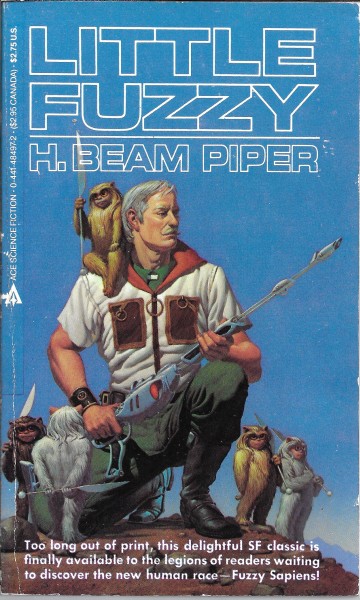
| The Michael Whelan cover isn't the original one…but…Michael Whelan |
H. Beam Piper was one of the greats from the Golden Age of Science Fiction, and his 1962 novel Little Fuzzy is a classic. Maybe the first "cute alien" novel, it was nominated for the best novel Hugo (back when the Hugo wasn't as divisive as everything else today). I've been re-reading Piper, and this passage near the beginning of the novel caught my attention. Great sf writers tend to see problems in human nature that are true in any time period, and Piper was no exception. Here is a psychologist speaking:
“If you don’t like the facts, you ignore them, and if you need facts, dream up some you do like,” she said. “That’s typical rejection of reality. Not psychotic, not even psychoneurotic. But certainly not sane.”
Piper understood the problems that have re-arisen today as well as anyone.
Little Fuzzy is public domain now, and you can find the novel at a number of sites to read for free. It's worth your time, and then some.
Warning: At the same time, though, I have to warn modern readers that Piper took a historian's approach to his work. He tried to be dispassionate about how a future history might unfold, for better but also worse. He expected the future would largely repeat the past, given that human nature would be the same. And so there's colonialism, the rise of a Hitler-analog…but to be fair, the flaws and evils are on full display.
Monday, January 26, 2026
Proof
"The Best Just Got Better"
-New Coke slogan
Its elegance,
its engines,
its exciting new features,
make other cars
seem ordinary
— Edsel advertisement, 1957
Now you can be as loud as you want with New Doritos Wow! Tortilla Crisps. They've got all the super loud, break-out-from-the-crowd taste of Doritos. And because they're made with OLEAN, they've got only 1 gram of fat at 1/3 fewer calories. So even with less fat, it's still…the loudest taste on earth. Wow!
"Everybody Needs A Yugo Sometime."
It was "like Pulp Fiction for the year 3000" and "like Star Wars, only better"
- John Travolta, promoting Battlefield Earth
Do you believe any of those?
You could certainly hear or read those words enough, back in the day. So the message was there, but who was receptive?
I'll put it another way. Why would anyone believe anyone's unsupported word on anything, especially when it's self-serving? The above are just examples, though they're infamous ones. New Coke was massively perceived as worse, Edsel is still a byword for failure, Wow! chips caused "anal leakage" (Wow! indeed), nobody needed a Yugo ever, and Battlefield Earth is on many "worst ever" lists.
And yet so many advertisers, politicians, and influencers expect you to take their word for things.
Since you can find anything on the internet, you can find plenty of claims that won't hold water. The earth is flat, we never went to the moon, vaccines are dangerous…the list goes on and on. And just as nonsensical as the ad slogans I started this with. Extraordinary claims require extraordinary evidence. Your product is best? Talk is cheap. Let's see some proof.
I'll talk more about it soon(-ish), but just keep this in mind for now: If someone suffers no penalty for inaccuracy, maybe don't trust their words. Furthermore, if they benefit from inaccuracy, maybe don't even listen.
There are reputable sources out there. But the self-serving, self-promoting, and even self-centered ones, not so much.
Thursday, December 25, 2025
Traders (New Free Ebook)
A two-bit trading caravan, a young man serving as lead guard for little more than meals. Traveling from one small, poor village to the next, barely making enough to survive.
The lead guard is young—too young. He's determined on a better life, but will his lack of maturity keep him from attaining it? Will he cause too much unthinking harm to others on the way?
What trade-offs will he have to make?
A free (but not public domain) ebook, though you'll need an account to download it:
https://self.gutenberg.org/eBooks/WPLBN0100751116-Traders-by-Johnson-Kevin-Wade.aspx?
Tuesday, October 21, 2025
We're Not Going to Make It
Wondering what brought on my last entry? Read on:
My wife recently had a terrifying medical emergency. Don't worry, she's recovered and doing really well. Still, she said after too long a time in the hospital, that if she'd been alone in the house when it happened, she'd probably be dead.
Terrifying. Makes me think of things like the image atop this entry.
I don't ever want to see her laid low like that again. I don't ever want to see her that ill. That frightened.
But it brought home something I've known since my father's death long ago. Life doesn't just keep going. "Happily ever after" can happen, but it won't be forever. Nothing is forever.
So, while I never want to see something like that again—or to go through an ordeal like I had in my own hospitalization a couple of years ago—I or we or she probably will.
Which is to say, we're fine for now…but not forever.
For those of you impatiently waiting for my next novel, take heart: it's written. It's been through a round of revisions, even. And it'll get another round, and be (self-)published. Only a matter of time.
For that matter, the novel after that is mostly written as well; over 80k words. But it's not going quickly. Nothing is right now, not for me. So take heart, and I'm sorry I'm taking so much time.
Time. "Too long a time." "Only a matter of time." How many meanings those words can take on.
Thursday, October 16, 2025
Turn Off My Heart
Be guided by my brain
My feelings overwhelm
Like a downhill train
Since I—
Since I—
Turn off my heart
I can't go on this way
Think and only think
Don't let my heart betray
Since I—
Since I—
Turn off my heart
I can't afford to feel
There's too much to decide
Must have nerves of steel
Since I saw you fall
Since I stood appalled—
Turn off my heart
Wednesday, October 8, 2025
Getting Rich Going Bankrupt
You may have noticed that there's at least one guy out there who's got all the money in the world, despite having business after business go bankrupt. How'd he do it? Well, I haven't dug into it all that deeply, but as far as I can tell, the trick to it is something like this:
1. Start a business2. Borrow a ton of money to expand the business
3. Make a lot of money off the business*
4. Don't repay the loans used for expansion
5. Declare bankruptcy for the business.
*Make sure the profits go in your personal pocket as much as possible, not the company's coffers.
A neat trick if you can do it—in a way. And, of course, it's not sustainable, because eventually no one is going to loan you any money.
Still…I can say a neat trick, but I certainly have to qualify it. After all, it's not the neatest solution for everyone. Sure, the person starting and running the business comes out of it really well, but nobody else does. The banks take a financial hit, and thus so do their owners or shareholders. The customers for the business can be left holding the bag on any advance purchases. And then there are the employees, who have to restart their careers through no fault of their own.
I guess on second thought there's nothing neat about it. Unless only one person in the world matters.
Wednesday, September 17, 2025
Democracy's Fatal Flaw
![]() |
| Front page political cartoon, "The Mascot", New Orleans, for 9 July 1887. "The Politicians' Serpents Tempting Our Democratic Eve" |
Democracy is based on the assumption that a million men are wiser than one man. How's that again? I missed something.and:
Autocracy is based on the assumption that one man is wiser than a million men. Let's play that over again, too. Who decides?
- Robert Heinlein, Time Enough for Love (pp. 245-6)
"Power tends to corrupt, and absolute power corrupts absolutely."
- Lord Acton
How do these all relate? I'll explain.
Autocrats like to think they're smarter or more special somehow than the rest of us—because if not, there's no justification for their authority. Whether they're politicians or in some less official position of power, they need an excuse for why they make decisions for the rest of us. (Or to put it another way, they need to justify taking decision-making away from the rest of us.)
So they pretend, or even have convinced themselves, that they alone are wiser than millions, and then have to justify that belief. Or try to.
It's a big reason why the USA's founders sought to limit the power of the government, and especially of whoever was atop the executive part of it. The founders had had their decisions taken away from them and given to those who were certainly less wise, and the founders not only didn't like it, they could see it made authoritarianism unstable. Some percentage of the population will always be restive, wanting that decision-making back.
So they put checks and balances in place in the Constitution, to try to keep the government under control.
They put the ultimate power, the decision-making, in the hands of the people, as much as they could.
Unfortunately, people aren't perfect, so their constructs, including governments, aren't either. They're flawed.
Democracy has the same fatal flaw as authoritarianism, actually. At some point, someone has to have the final say on decisions, and whoever it is won't be perfect. Or even wise. Certainly not incorruptible, not always.
Whoever has that authority needs to be reined in. There need to be checks and balances on them, so they don't just follow their whims or wishful thinking. Or temptations.
Unfortunately, the same is true of voters. The problem is, where checks and balances are concerned in the USA and too many other democracies, they're lacking. No checks, no balances. Not on the voters.
There's nothing to stop voters from voting for unconscionable candidates, for idiotic ideas, for counterproductive propositions.
Just look at the election that started Hitler off decades ago, eventually bringing down Weimar Germany. Or look at some more recent elections, in any number of democratic states. There's nothing stopping voters from looking only at the immediate, and taking their eyes off the long-term. To look only at what's bothering them right now, and not what is best for all, decades down the road.
Power tends to corrupt, and absolute power absolutely. It applies to voters the same as anyone else.
And other than those same voters making sure they have accurate and reliable information, even if unwelcome, to base their decisions on; those voters ensuring they're looking at everyone's needs and not just their own, no matter how pressing; those voters fighting to keep the power they have from leading them to corrupt choices, no matter how tempting…there is no answer.
Voters have to be wise; their power is unchecked.
And I'm sorry about that. I've thought and thought and thought about this, and I don't have any better solution. I wish I did.
Then again, the founders didn't either. Did they?
* * *
I realize it may sound from this like all political systems are flawed, so it doesn't matter which you're under. The first part is true, but the second is not.
Tyranny, historically, has restricted the rights and choices of individuals. Communism creates a power vacuum that a tyrant inevitably fills. Aristocracy ends up being unmerited elitism.
Democracy is still the best choice, if the welfare of the individual matters to you.
But that's best choice, not perfect choice. With people or politics, there is no perfection, no easy way out. Only the hard work of learning the issues and the candidates, making the best choice for the long term, not yielding to temptation.
"Eternal vigilance is the price of liberty." If voters stop being vigilant…the price is all too high.
Saturday, August 23, 2025
The Fatal Flaw of Authoritarianism
![]() |
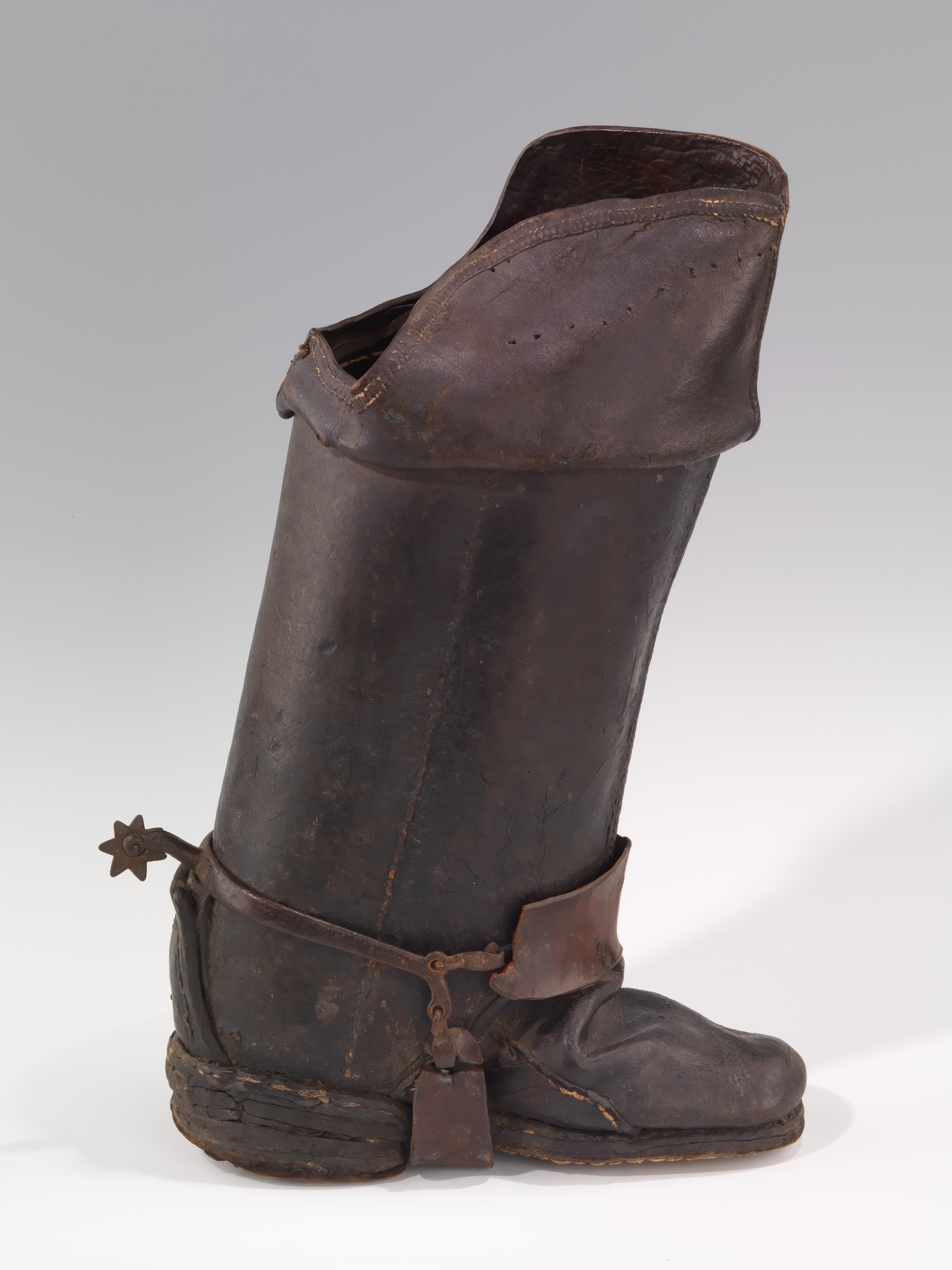
| A jackboot |
I remember, all too vividly, being a young man, and finding I could be attractive to women—some women. The world being what it is, temptation came my way. Suffice it to say, things did not go well.
What does that have to do with authoritarianism? Bear with me a moment.
The appeal of a single individual taking charge is pervasive within humanity, or so it seems. Even the more collectively minded cultures are prone to doing this. How many dictators have there been in group-centered cultures? As many as in the more individualist ones, I'm certain.
Or if that argument doesn't sway you, how about this? How many corporations anywhere don't have a CEO?
Or how about a Heinlein quote on the subject, from Time Enough for Love (p. 246)?
Autocracy is based on the assumption that one man is wiser than a million men. Let's play that over again, too. Who decides?
(It comes after his one-liner on democracy:
Democracy is based on the assumption that a million men are wiser than one man. How's that again? I missed something.
(It just goes to show that governing isn't simple.) (If it was, we would all have the same form of government, and wouldn't be having discussions like this.)
The fact is, all forms of government have a fatal flaw, it's just more pronounced in an authoritarian form. One more quote explains why:
"Power tends to corrupt, and absolute power corrupts absolutely."
- Lord Acton
If you've got an autocrat in place, his (it's almost always a he) whims have nothing to check them. He can issue an edict, and it has to happen, no matter how bad it might be for however many people. This is why the Roman Republic and the USA put checks and balances in place, to keep this kind of corruption under control.
Until it's evaded, anyway.
Consider if your autocrat is tempted to, for example, exile anyone who criticizes him, what's to stop him? Or from denying anyone governmental protections? Seize their property?
Do I seem to be doom-mongering? Overreacting?
I don't think so. I know from personal experience what happens when something tempts you, and there's nothing to stop you yielding.
Sunday, July 13, 2025
Propaganda vs. Journalism
![]() |
| This is from 1894, not 2024 |
Introduction
Misinformation is bad enough. Disinformation—meant to mislead—is even worse. And there's a lot of it out there. It's been a problem probably ever since town criers started bawling, but it's gotten worse lately. There are propaganda outlets masquerading as media. If you want to make intelligent decisions, you need to be able to tell propaganda apart from reputable journalism.
Example
I found when teaching that there's nothing better than a good example. I managed to dig up something from Chinese state media back in 1961. The distance in time and foreign origin should defuse anything inflammatory, and enable easier analysis. I'm going to put some words in italics:
This coup was reactionary, and deliberately engineered by the American imperialists. After the American imperialist running dog Syngman Rhee was toppled, [they] brought Jang Myeon [Chang Myun] to power, bringing in so-called American-style “democracy” with the scheme to strengthen their colonial rule in South Korea. But since last April the people’s struggle had been growing by the day, the struggle for peaceful reunification gathering more and more steam. … So in advance they engineered a so-called “military coup”, with the purpose of suppressing the South Korean people’s struggle and strengthening fascist rule.
- https://digitalarchive.wilsoncenter.org/document/cable-chinese-embassy-north-korea-contents-may-18th-north-korean-party-central-standing
Analysis
Things like the above used to come out of Chinese state media all the time. (Nowadays they're a little more subtle.) But let's examine it. We'll start with everything I put in italics, divided up into three groups:
1. reactionary, engineered, imperialists, scheme, colonial, people's struggle, peaceful
2. so-called "democracy"/"military coup"
3. running dog, fascist
Group 1 consists of words with emotional loading. Neutral terms, which don't evoke an emotional reaction, would be "conservative," "facilitated," (I can't think of one for "imperialist"—maybe "expansionist"), "plan," "conflict," "foreign," "non-violent." Note that in the cases of "people's struggle" and "peaceful," the emotions meant to be elicited are positive.
Group 2 consists of redundant phrases with scare quotes. Scare quotes are meant to scare, on some level, which makes them a variant on the kind in group 1.
Group 3 consists of insults, terms meant to denigrate. Again, meant to make the audience react emotionally.
(One other note: a lot of "they" in that example, with "they" never quite defined. It's easier to cast blame without accountability if you never specify who you're blaming.)
Journalism and Propaganda
Now, these bits from Wikipedia are useful (they come from the Journalism and Propaganda entries):
⦁ "Journalism is the production and distribution of reports on the interaction of events, facts, ideas, and people that are the "news of the day" and that informs society to at least some degree of accuracy."
⦁ "Propaganda is communication that is primarily used to influence or persuade an audience to further an agenda, which may not be objective and may be selectively presenting facts to encourage a particular synthesis or perception, or using loaded language to produce an emotional rather than a rational response to the information that is being presented."
The key words from each include "informs" vs. "influence," and "accuracy" vs. "emotional…response." Journalism has a different goal from propaganda. If you can't tell them apart you can easily be misled, being influenced when you were open to being informed.
Distinguishing Between the Two
Reputable journalists are trying to give you the facts and the context so you can make up your own mind. They don't seek to persuade. (Editorials are something separate, and are not a problem if labeled as such and kept apart from news stories.)
Journalists will often point out potential consequences, but try not to let their own biases creep in, and try not to use alarmist (emotional) language. That can of course be difficult. But the goal is for rational reaction, not emotional.
But if you read or watch information sources, whether they call themselves news or not, sources that consistently or even constantly use loaded words and emotional language, if the reporters resort to insults, well, go ahead and follow that outlet if you want to. Just keep in mind you're watching something where influence is the goal, and the message trumps accuracy. Watch or read it if you want. But don't trust it.
Thursday, July 3, 2025
Five Things Wrong with Today's Party in Power
With the Fourth of July here, this seems like a reasonable time to take a look at the current
1. All They Value Is Money Help for the poor? Efforts to reduce inequality? Education or training assistance? Nope. To today's government leadership, if you haven't earned a lot, there's something wrong with you. Likewise, if the field you're in isn't high-earning, then they view you as having made foolish choices, and, again, deserve nothing. So much for farmers, nurses, firefighters, police officers…
2. All They Value Is Power I The will of the people? A government by, for, and of the people? Not so much. A government where they make the decisions is paramount, and whatever means it takes to get to that end, they will use.
3. They Can't Handle the Truth You may have noticed that just about any policy, statement, or anything else that comes out of the administration doesn't align with science, facts, or reality. Nor do they care about expertise, education, or experience. Why? Because truth isn't something they can exploit. Truth does not bring power—not that they can see.
4. All They Value Is Power II The ultimate political power is that which has no checks upon it, and no balance with competing authorities. This is primarily why Congress has been so inactive and the Supreme Court so permissive, even with both being controlled by the
5. They Can't Handle Opposition We'll see how far they go in this respect. But, so far, they've at least threatened to arrest or deport anyone who gets in their way, including judges and legislators. Fortunately, this blog is too minor to be on their radar. Otherwise they might consider me a threat. Then who knows what will happen. But I'm safe. Aren't I? They won't come for me. Will they?
Will they?
Happy Independence Day.
Except…independence from what?
.jpg)


.jpg)


.png)

.jpg)